
The golf downswing represents one of sport’s most explosive movements, occurring in mere milliseconds yet determining the fate of every shot. For recreational golfers struggling with inconsistent ball-striking and limited distance, the solution lies in mastering two fundamental principles: establishing a stable lead side while generating power through an active trail side.
The Foundation of Powerful Ball-Striking
The downswing sequence begins with the lower body, creating a kinetic chain reaction that transfers energy through your upper body and into the clubhead. This weight transfer from your trail side to your lead side provides the stable foundation necessary for the upper body to unwind naturally, allowing golfers of modest physical stature to generate impressive clubhead speed.
The critical moment occurs in mid-downswing, when your lead leg firms up and stabilizes, creating a post around which your trail side can drive aggressively toward the target. When golfers cannot effectively shift their weight toward the target and clear their hips out of the way, the lower body becomes an obstacle that forces the arms and club to swing on an outside-to-inside path, producing the dreaded slice.
Model Pro Key Characteristics
The photos accompanying this article demonstrate the fundamental differences between professional and amateur swing patterns:
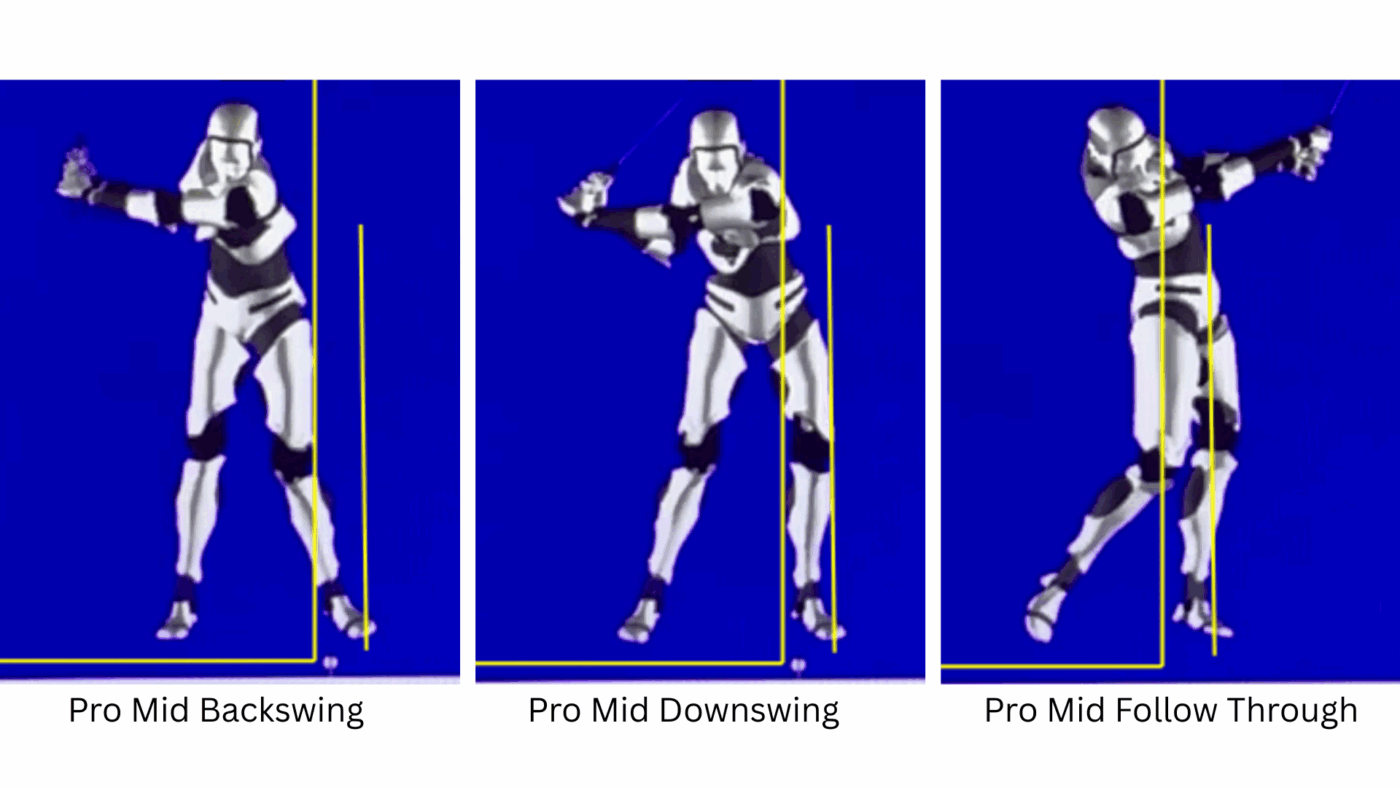
Professional Swing Sequence:
- Mid-Backswing: Pro has shifted and turned onto the trail side, properly loading the trail leg
- Mid-Downswing: Pro has shifted the lower body toward the target with most weight and force on the lead leg making way for the arms to follow an inside path
- Mid-Follow Through: Pro stabilizes the lead side setting a natural release of the club while the trail side (right shoulder, hip, and knee) continues moving toward the target

Common Amateur Mistakes:
- Mid-Backswing: Turning in place like a barrel rather than shifting and turning to load the trail leg
- Mid-Downswing: Limited lower body shift fails to maximize force transfer to the lead leg, losing power
- Mid-Follow Through: Lead leg spins out and moves backward instead of remaining stable, creating an out-to-in swing path
Practice Drills for Immediate Improvement
Bump the Stick: Place an alignment stick two inches to the right of your trail hip. Focus on shifting away from the target early in the takeaway, completing this movement by the time your club reaches parallel to the ground.
Step and Swing: Begin with feet together at address. As your backswing reaches halfway, step toward the target with your lead foot while completing the backswing. This creates the proper sequence and whip-like acceleration through impact.
Shift and Turn to Stick: Position an alignment stick opposite your lead heel five inches toward the target and five inches behind your lead heel. Practice shifting your lower body toward the target while rotating your hips to finish with your hips touching or near the stick.
Balance and Tempo: Sometimes working on your swing can disrupt your balance and tempo. A great number of downswing and follow through positions are rooted in the same cause: failure to utilize the lower body and trail side forcefully in the downswing. However, in doing so it is important to do this while maintaining good balance and tempo.
You Tube video link: Click here to see a video of how to add power and accuracy to your swing.
Key Takeaway
By incorporating these fundamental movement patterns – a stable lead side and an active trail side – into your swing, you’ll experience the satisfying combination of longer drives and more fairways hit. The source of most recreational golfers’ distance and accuracy problems lies in poor downswing mechanics, but with focused practice on these two key elements, you’ll develop more consistent, powerful ball-striking that will transform your game.
